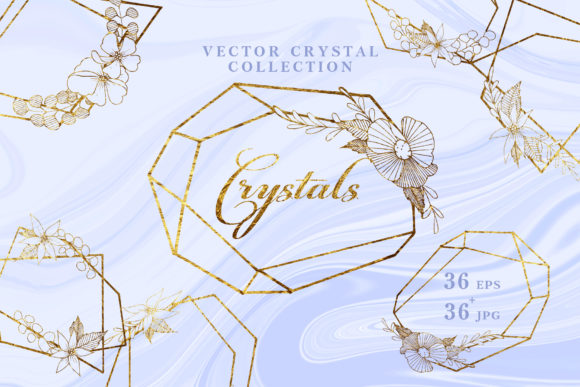
Vector Collection of Crystal Shapes: A Versatile Asset for Creative Workflows
For designers, content creators, and small business owners, having a reliable set of visual assets that can be adapted across multiple projects is a significant advantage. The Vector Collection of Crystal Shapes offers exactly that: a curated set of 72 files that blend hand-painted aquarelle elements with clean, editable vector graphics. This is not merely a clipart bundle; it is a flexible resource that fits into production-oriented workflows, from initial concept development to final print-ready files. Understanding how to prepare, integrate, and reuse such a collection can streamline your creative process and improve consistency across projects.
What the Collection Includes and Where It Belongs
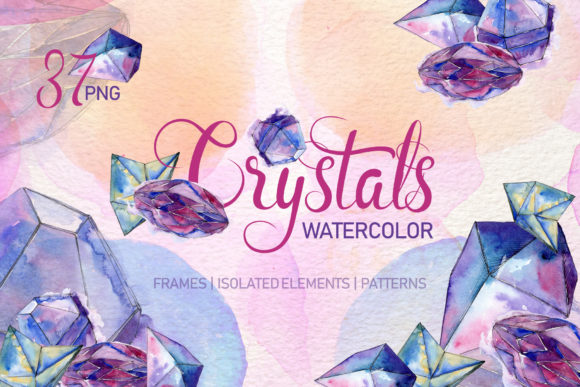
The pack contains 36 EPS files and 36 JPG files, covering frames, borders, patterns, and isolated crystal illustrations. Each image is highly detailed and separate, which is critical for efficient asset management. The PNG files come at 300 dpi with transparent backgrounds, making them ready to drop into any layout without extra masking. Patterns and frames are provided as JPGs at 3500x3500 pixels, a resolution that supports high-quality print output for posters, invitations, and signage.
This collection sits naturally in the pre-production and production phases of a creative project. Before you begin a design, these assets serve as inspiration for color palettes, texture overlays, or structural elements. During the build phase, they function as modular components that can be resized, recolored, or combined without technical friction. After a project is completed, they remain reusable for future work, which reduces the need to commission new illustrations for every campaign.
Preparation and File Organization
Before integrating the Vector Collection of Crystal Shapes into a workflow, take time to organize the files in a way that matches your naming conventions and folder structure. Because the pack contains both vector (EPS) and raster (JPG) formats, separate them by type and by usage category. For example, create folders for Isolated Elements, Frames and Borders, and Patterns. Within each, maintain the original file names or add metadata tags like “crystal_blue_frame,” “watercolor_pattern_rose,” or “gold_vertex” to speed up retrieval later.
If you work in Adobe Illustrator or Affinity Designer, importing the EPS files directly preserves the vector paths, allowing you to change colors, scale infinitely, and edit anchor points. For those using Canva or similar online tools, the transparent PNGs are ideal because they drop in without background removal. Ensure your software can handle EPS files; most industry-standard vector editors do, but if you rely solely on pixel-based apps, stick with the JPGs and leverage their high resolution for sharp prints.
Compatibility and Format Considerations
The EPS files are fully editable in terms of size, color, and composition. This means you can extract individual crystals from a pattern, change the stroke weight of a border, or combine multiple frames into a custom shape. The JPG files, though raster, are large enough (3500 pixels) to be used as backgrounds or textures on A3-sized documents without pixelation. For web use, you can downsample them to reduce file size—ideal for blog headers, social media graphics, or email templates.
One practical tip: when working with the JPG patterns, convert them to smart objects in Photoshop if you need to transform them non-destructively. This preserves the original resolution and allows scaling without loss. For the EPS vectors, always save a copy as an AI or SVG file if you plan to revisit the design later, as some apps may not read EPS perfectly across versions.
Integrating the Collection into Project Workflows
The true value of a well-structured asset library emerges when you embed it into repeated workflows. Here are a few ways the Vector Collection of Crystal Shapes can be used before, during, or after key project stages.
Before a Project: Inspiration and Mood Boarding
When starting a new design—whether it’s a wedding invitation suite, a product catalog, or a social media template—open the isolated crystal shapes and patterns to explore color schemes and compositional ideas. The hand-painted aquarelle textures carry organic variation, which can break up overly digital flatness. Drag three or four frames into a blank canvas to see how they interact with your typography. This early exploration helps you decide whether to use a border as a full-page frame or a small accent element.
During Production: Modular Assembly
Because each image is a separate file, you can treat them like building blocks. For a greeting card, you might select one frame, one pattern, and two isolated crystal shapes (e.g., a large diamond and a small cluster). Using a layered approach in your design software keeps the background pattern on one layer, the frame on another, and the crystal elements on top. This modularity allows quick iteration: swap the frame style, change the pattern’s opacity, or recolor the crystals to match a brand palette. The EPS vector format makes color editing trivial—simply select the fill and adjust the hex value.
After Completion: Asset Archiving and Reuse
Once a project goes to print or online, do not discard the working file. Save the final design as a template with the crystal elements embedded. Next time you need a similar piece (e.g., another wedding invitation or a thank-you card), you can duplicate the template and replace only the text and specific crystal illustrations. This reduces repetitive work and ensures visual consistency across collateral. Because the collection includes 72 distinct files, you can rotate through different frames, borders, and patterns without your designs looking recycled.
Practical Use Cases and Real-World Examples
The Vector Collection of Crystal Shapes is not limited to one niche. Its versatility comes from the blend of natural aquarelle textures and clean geometric shapes. Below are scenarios where these assets integrate smoothly into different professional workflows.
- Wedding and event invitations: Use a lace-like border frame for the main card, a subtle crystal pattern as a background envelope liner, and isolated crystal illustrations for place cards or favor tags. The high-resolution JPGs ensure crisp text over the pattern.
- Greeting cards and stationery: Combine a frame with a transparent background (PNG) and a single crystal shape as a focal point. Because the elements are hand-painted, they convey a bespoke feel that customers often associate with studio-made products.
- Blog and social media graphics: For top-of-article headers, drop a pattern at reduced opacity over a solid background. The aquarelle texture adds depth without distracting from text. Use isolated crystals as bullet points or dividers between sections.
- Posters and print-on-demand: Scale the EPS frames to any size without quality loss. Layer multiple crystal shapes to create mandala-like compositions. Because the files are fully editable, you can create unique designs for POD platforms like Redbubble or Society6.
- Branding and packaging: Use a crystal border as a decorative element on product labels, or extract a single pattern tile to repeat on tissue paper or box liners. The JPG patterns at 3500 pixels can tile seamlessly if aligned correctly.
Quality Control and Consistency
Working with a mixed-format collection requires careful quality checks, especially when transitioning between vector and raster files. For print projects, always export your final layout at 300 dpi and verify that the crystal elements appear sharp. Since the JPG patterns are 3500 pixels, they will cover most standard print sizes without issues. However, if you scale a JPG pattern larger than 100% in your design software, you may introduce pixelation; plan your layout so that the pattern area fits within the original dimensions.
For digital use, export at 72 or 150 dpi to keep file sizes manageable. The PNG files with transparent backgrounds are especially useful for web graphics because they do not require clipping paths. Test the transparency against your intended background color—light or dark—to ensure the edges blend naturally. The hand-painted textures have soft edges that work well on white or pastel backgrounds; if you place them over dark surfaces, consider adding a subtle drop shadow or white stroke to separate the element from the background.
Consistency Across Multiple Projects
One of the biggest challenges in branding is maintaining a cohesive look across different materials. By using the same vector collection as a foundation, you create a visual thread. For instance, pick two frames and three crystal shapes as your default set for a season. Apply them to invitations, menus, thank-you cards, and website banners. Clients and audiences will perceive a unified design language. Because the collection includes 72 files, you can vary the combinations enough to avoid monotony while still adhering to a core aesthetic.
Long-Term Use and Scalability
Investing in a structured asset pack like this pays off over time. The EPS vector files are resolution-independent, meaning you can scale them for a business card now and for a billboard later without re-purchasing. The PNGs, while fixed in size, offer a high ceiling for most print applications. Store the master files in a cloud-synced folder or on an external drive with a clear index. If you find yourself frequently using certain elements—for example, the frame with gold highlights—consider creating a shortcut or custom brush from it in your design software to speed up placement.
For teams, the collection becomes a shared resource. Designers can pull from the same set without worrying about version discrepancies. Establish guidelines on when to use the vector versus raster versions: use EPS for any element that might need recoloring or scaling, and use JPG/PNG for quick placements on backgrounds where resolution is adequate. This prevents accidental degradation of vector quality by unnecessary rasterisation.
Final Thoughts on Integration
The Vector Collection of Crystal Shapes is more than a one-time download; it is a tool that fits into a bigger creative system. By understanding its structure—72 files, both vector and raster, printed and digital-ready—you can plan projects with less friction. Spend the initial time organizing and testing the files, then move into execution with confidence. Whether you design a single invitation or manage a series of branded materials, this collection provides the variety and quality needed to maintain a professional standard. The real efficiency comes not from having many assets, but from knowing how to deploy them at the right moment in your workflow.