Fashion Prints Watercolor: A Practical Evaluation for Digital and Print Projects
Watercolor digital assets occupy a distinct space in design resources, offering a handcrafted aesthetic without requiring traditional painting skills. The Fashion Prints Watercolor collection, which includes 38 PNG files and complementary JPG patterns and frames, presents itself as a versatile toolkit for creators working on invitations, branding, social media, and printed materials. Understanding what this pack actually delivers, where it excels, and where it may fall short can help you determine whether it aligns with the specific demands of your project.
What the Fashion Prints Watercolor Collection Actually Contains
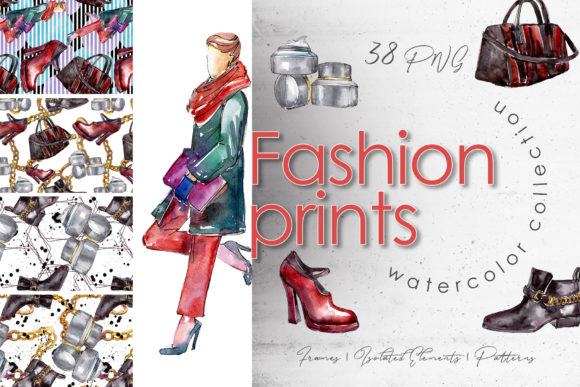
This set comprises 38 separate PNG files, each featuring a hand-painted watercolor element. The collection includes frames, borders, patterns, and isolated illustrations, all rendered at 300 dpi with transparent backgrounds. The transparent PNG format means each element can be placed directly into a design file without additional masking or background removal. The patterns and frames are supplied as JPG files sized at 3500x3500 pixels, which provides a generous canvas for both digital and print applications up to roughly 11.7 x 11.7 inches at 300 dpi.
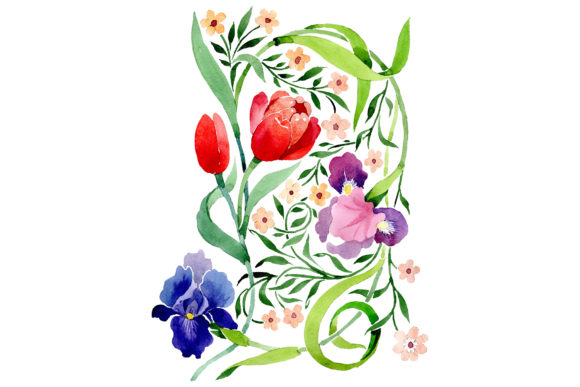
Because every image is a separate file, you can mix and match elements freely without needing to extract components from a single composite. The Aquarelle style—characterized by soft, flowing pigment and subtle bleeding edges—gives the collection a cohesive look that can be used as background texture, pattern overlay, or structural frame. The term "Fashion Prints Watercolor" reflects the stylistic influence of fashion illustration, with elements that often feature graceful curves, botanical motifs, and delicate line work reminiscent of haute couture sketching.
Evaluating the Real Strengths of This Resource
One clear advantage is the editability of these files. Because the PNGs have transparent backgrounds, you can resize, recolor, and reposition each element without degrading the image quality, as long as you work within the original resolution limits. The 300 dpi resolution is a meaningful specification for print projects: it ensures that when you place an element into a layout, it will render cleanly without visible pixelation at typical print sizes.
The handmade quality also deserves consideration. Each element was physically painted with watercolor and then digitized, which means the textures, variations in pigment density, and subtle brush strokes are authentic rather than digitally simulated. For designers who want a natural, organic feel in their work, this can be a significant time-saver. Reproducing genuine watercolor texture through digital painting is time-consuming, and achieving the same level of granular variation often requires specialized brushes and a practiced hand. This collection effectively shortcuts that process.
Versatility is another practical benefit. The same frame element could serve as a border for a wedding invitation, a decorative surround for a quote graphic, or a thematic accent on a blog header. The isolated illustrations—individual flowers, leaves, or ornamental shapes—can be scattered across a poster design or used as bullet points in a presentation. The patterns, being JPG at a uniform size, work well as backgrounds for social media graphics or as fabric print mockups.
Important Tradeoffs and Considerations
While the collection offers considerable utility, it also comes with limitations that matter depending on your workflow and end use. The PNG files, while high resolution, are raster images. This means that scaling them beyond their original dimensions will introduce pixelation, unlike vector formats such as SVG or AI. If your project requires a single element to cover a large poster or billboard, you may encounter resolution constraints. For typical uses like greeting cards, invitations, or digital posts, however, the provided resolution should be sufficient.
The patterns and frames being in JPG format rather than PNG is another tradeoff. JPGs do not support transparency, so if you place a pattern over a colored background, you will have a white rectangle behind the pattern unless you take extra steps in your editing software to remove it. This adds a step for certain design scenarios, especially if you plan to overlay patterns on top of other elements. If your project relies heavily on layered compositing, the JPG limitation may slow you down.
Another practical consideration is file management. With 38 separate files, organizing and previewing the collection takes some upfront effort. Most design software will handle this, but if you prefer a single-file resource like a vector library or a layered PSD, the individual-file system may feel less efficient. Additionally, because the elements are hand-painted, no two are exactly identical in color distribution or texture. While this is a strength for authenticity, it can be a challenge if you need perfectly uniform repeats in a pattern or exactly matching border segments for a multi-page document.
Scenarios Where This Collection Is a Strong Fit
The Fashion Prints Watercolor pack works well for projects where a cohesive, handcrafted watercolor look is desired and where production volume is moderate rather than mass-market. Wedding and event stationery is a natural application: the frames and borders can be used for invitations, RSVP cards, and programs, while the isolated elements can decorate envelopes or favor tags. Because watercolor conveys a romantic, soft aesthetic, it aligns well with wedding themes, especially garden, bohemian, or vintage styles.
For content creators who produce quote graphics, blog headers, or social media posts, the high-resolution backgrounds and patterns provide a quick way to add visual depth. The 3500x3500 pixel patterns can be cropped or resized to fit most social media dimensions while retaining enough resolution for print-on-demand items like mugs or phone cases. The transparent PNGs also simplify compositing quotes over a watercolor wash without the need for complex layer masking.
DIY enthusiasts and small-scale sellers will also appreciate the flexibility. If you create handmade greeting cards, planners, or art prints, having pre-made watercolor elements that you can print directly or edit digitally can cut production time significantly. Because the files are fully editable in terms of size, color, and placement, you can adapt them to different product lines without starting from scratch each time.
When Alternatives Might Serve You Better
This collection is less suitable for projects that demand vector scalability. If you are designing large-format signage, vehicle wraps, or anything that needs to be printed at billboard size, raster images will fail at extreme scale. In those cases, a vector-based watercolor effect set or a subscription to a vector asset library would be more practical, even though it may lack the genuine painted texture.
Similarly, if your workflow is entirely vector-based and you rely on path editing and color swatch control, the raster nature of these files will be a friction point. You will not be able to edit individual brush strokes or separate elements by color channel without destructive editing. For corporate branding, where exact color consistency across all materials is mandatory, the natural variation in hand-painted watercolor may also be a liability rather than an asset.
For projects that require a large number of perfectly repeating seamless patterns, the JPG patterns in this set may not offer the precision you need. Seamless vector patterns or programmatically generated textures would give you more control over repeat placement and edge matching. Additionally, if you need a massive library of elements—hundreds of illustrations rather than 38—a larger commercial collection or a custom commissioning approach might be more cost-effective in the long run.
Practical Insights for Making Your Decision
Before purchasing, consider the specific dimensions and format requirements of your primary project. If you are designing for print at a standard size like 5x7 inches or A5, the 300 dpi PNGs are more than adequate. For digital use, the resolution is generous and allows for cropping without significant loss. Check what software you will be using: the files work well in Adobe Photoshop, Affinity Photo, Procreate (for iPad), and Canva (Pro). If you use software that does not support layered PNGs well, such as some basic word processors, the JPG patterns may be easier to insert directly.
Color editing is possible but understand the format limitations. You can apply hue/saturation adjustments, color overlays, or gradient maps to the PNGs in most image editing programs, but the underlying brush textures will remain. If you need a more uniform color wash, you may need to desaturate the element and add your own color layer beneath it. The JPG patterns, being opaque, require more effort to recolor because you need to remove the white background first.
Think about the aesthetic continuity across your project. Because all 38 files come from the same hand-painted source, they share a consistent style. This is beneficial for maintaining visual harmony, but it also means that if you need a completely different watercolor look—say, more abstract or more botanical—you would need to supplement this pack with other resources. The term "Fashion Prints Watercolor" signals a specific elegance and fashion-sketch sensibility, so it may not suit rustic, childlike, or hyper-realistic watercolor themes.
Finally, evaluate your tolerance for file organization. The 38 individual PNGs and separate JPGs require some upfront sorting. If you plan to use only a few elements, this is trivial. If you intend to build a large library of designs, creating a folder structure and preview system will save time later. Some users enjoy the flexibility of having each element as a standalone file; others prefer a single file with multiple layers. Your personal workflow preference matters here.
The Fashion Prints Watercolor collection is a functional, aesthetically cohesive resource for creators who need genuine hand-painted watercolor elements in a high-resolution, editable format. Its strengths lie in the authenticity of the brushwork, the versatility of transparent PNGs, and the practical print-readiness of 300 dpi files. Its limitations revolve around raster scalability, JPG opacity in the pattern files, and the need for individual file management. For wedding stationery, greeting cards, blog graphics, and small-scale printed products, it offers a balanced combination of quality and convenience. For vector-intensive, large-format, or perfectly uniform projects, a different approach may be worth considering. By matching the pack's characteristics to the specific demands of your work, you can make an informed decision that supports both your creative goals and your practical timeline.